Skip to content
Small Cell 5G Network | Network Densification | mmWave | Regional Breakdown | April 2026 | Source: WGR
| $58.4B | 27.3% | $7.6B |
|---|---|---|
| Market Value by 2032 | CAGR (2024-2032) | Market Value in 2024 |
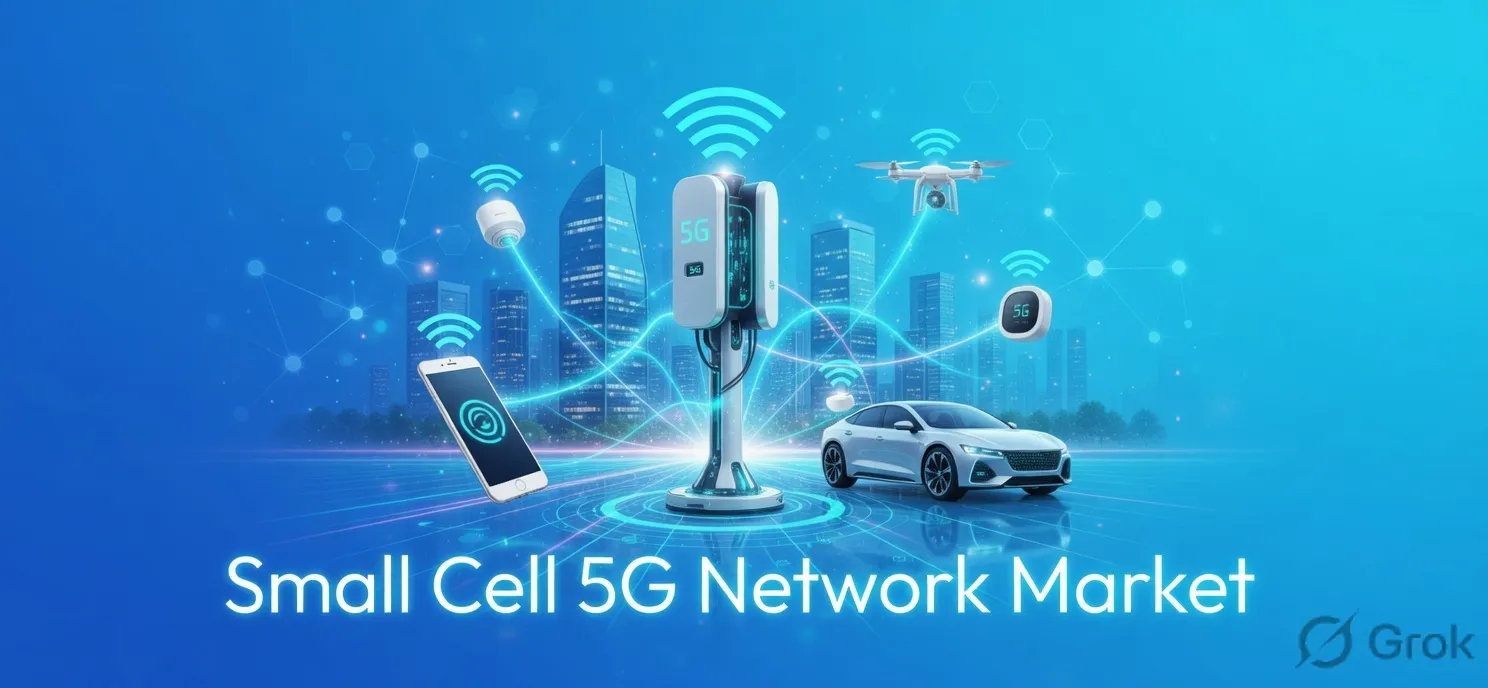
Small Cell 5G Network Market
Key Takeaways
-
Small Cell 5G Network Market is projected to reach USD 58.4 billion by 2032 at a 27.3% CAGR.
-
mmWave and sub-6 GHz small cell deployment in urban dense areas is the dominant structural growth driver.
-
Open RAN (O-RAN) compatible small cells are gaining traction among tier-2 and greenfield operators demanding vendor flexibility.
-
Nokia, Ericsson, Huawei, ZTE, Samsung Networks, CommScope, Corning, and Fujitsu lead competitive supply.
-
Asia-Pacific leads deployment volume; North America and Europe accelerate through enterprise private 5G adoption.
The Small Cell 5G Network Market is projected to grow from USD 7.6 billion in 2024 to USD 58.4 billion by 2032 (27.3% CAGR), driven by the mass-market deployment of mmWave and sub-6 GHz small cells across urban and suburban environments, the expansion of Open RAN-compatible small cell architectures into brownfield operator networks, and the proliferation of private 5G networks in enterprise and industrial campuses.
Market Size and Forecast (2024-2032)
| Metric | 2024 Value | 2032 Projected Value / CAGR |
|---|---|---|
| Small Cell 5G Network Market | USD 7.6B | USD 58.4B | 27.3% CAGR |
Segment & Technology Breakdown
| Technology | Segment | Primary Buyer | Key Driver |
|---|---|---|---|
| mmWave Small Cells | Urban Dense, Stadiums | Tier-1 MNOs | Gigabit throughput, low latency |
| sub-6 GHz Small Cells | Suburban, Indoor | MNOs, Enterprises | Coverage extension, capacity offload |
| Open RAN (O-RAN) | Greenfield, Tier-2 | Alternative Operators | Vendor diversity, cost reduction |
| Private 5G Small Cells | Industrial, Enterprise | Manufacturers, Logistics | Dedicated spectrum, ultra-reliable |
What Is Driving the Small Cell 5G Network Market Demand?
-
Network Densification Mandate: The physical limitations of macro-only 5G coverage are accelerating small cell deployment as operators require 10-20x more cell sites to deliver mmWave performance, with urban small cell density projected to reach 50-100 units per square kilometer in major metros by 2028.
-
Open RAN Disruption: O-RAN-compliant small cells are gaining traction among tier-2 operators and private network builders seeking to avoid vendor lock-in, commanding 20-30% lower total cost of ownership compared to proprietary integrated solutions.
-
Private 5G Enterprise Surge: Manufacturing floors, logistics hubs, and mining operations are deploying dedicated small cell networks for real-time asset tracking, autonomous mobile robots, and predictive maintenance, with validated productivity improvements of 15-25% and ROI payback of 12-24 months.
-
Indoor Coverage Imperative: Enterprises and venue operators are investing in distributed antenna system (DAS) alternatives as small cells deliver superior capacity density for stadiums, airports, and convention centers at 40-50% lower deployment cost than traditional DAS.
KEY INSIGHT
Tier-1 mobile operators deploying 5G mmWave small cells in urban corridors report a 15-25x capacity increase over macro-only 5G and a 40% reduction in customer-reported dead zones, with validated small cell payback periods of 18-30 months across dense North American and Asian metropolitan areas.
Get the full data — free sample available:
→ Download Free Sample PDF: Small Cell 5G Network Market
Includes market sizing, segmentation methodology, and regional forecast tables.
Regional Market Breakdown
| Region | Maturity | Key Drivers | Outlook |
|---|---|---|---|
| North America | Mature | mmWave spectrum utilization, CBRS private networks | Steady; open RAN adoption growing |
| Europe | Strong | Industrial 5G, greenfield operator mandates | Strong; private 5G accelerating |
| Asia-Pacific | Dominant | Massive urban density, government subsidies | Highest volume; China, Japan, Korea lead |
| Middle East & Africa | Expanding | Smart city projects, stadium deployments | Growing; mmWave segment leading |
| Latin America | Emerging | Spectrum auctions, urban coverage gaps | Moderate; sub-6 GHz growth |
Competitive Landscape
| Category | Key Players |
|---|---|
| Integrated RAN Vendors | Nokia, Ericsson, Huawei, ZTE, Samsung Networks |
| Open RAN Specialists | Mavenir, Parallel Wireless, Altiostar (Rakuten) |
| Small Cell Hardware | CommScope, Corning, Fujitsu, Baicells |
| Private 5G Platforms | Celona, Druid Software, Airspan |
Outlook Through 2032
mmWave densification, Open RAN commoditization, and private 5G enterprise adoption will define the small cell 5G network market through 2032. Vendors investing in O-RAN compliance, energy-efficient small cell designs, and plug-and-play private 5G solutions will capture the highest-margin operator and enterprise contracts as small cells transition from coverage gap-filler to primary 5G capacity layer.
Access complete forecasts, segment analysis & competitive intelligence:
→ Purchase the Full Small Cell 5G Network Market Report (2025-2032)
*7-year forecasts | Segment & application analysis | Regional data | Competitive landscape | 200+ pages*
Keywords: Small Cell 5G | 5G Network Densification | mmWave Small Cell | Open RAN | Private 5G | Sub-6 GHz | O-RAN | Mobile Network Infrastructure
© 2025 WiseGuy Reports (WGR) · All Rights Reserved · wiseguyreports.com
All market projections are forward-looking estimates sourced from WGR’s proprietary research reports and subject to revision.